
Volusia County Court Records After a Jail Arrest
An arrest in Volusia County sets off a clear chain of steps. First, deputies or officers book the person into the Volusia County Branch Jail. Within about one day, the person stands before a judge at First Appearance. The judge reads the charges and reviews probable cause. Then the Office of the State Attorney, Seventh Judicial Circuit, decides what formal charges to file. Those filed charges become the court record for the case. The Clerk of the Circuit Court opens and keeps that record. So the arrest starts the process, but the court records are built by the prosecutor and the Clerk over the days that follow.
It helps to keep two sides apart. The custody side lives at the jail. For who is in custody and booking detail, the jail inmate records page covers the roster, and booking photos are explained on the jail roster mugshots page. The court side is the case itself. Booking charges on the roster can read one way at arrest, then change once the State Attorney files. The official charges, dockets, and outcomes are court records held by the Clerk, not the jail.
How to Find Volusia County Court Records After an Arrest
The Clerk runs the search tools for court records. The Case Inquiry portal lets the public look up a criminal case by name or case number. The jail roster shows arrest and booking detail, but the filed charges and case status live with the Clerk. Recent arrests need a short wait. Court dates are usually processed by the Clerk one to two days after First Appearance, so a brand-new case may not show full detail right away.
- Open the Volusia Clerk Case Inquiry, reachable from the Clerk Search Records page, and accept the disclaimer.
- Search by the defendant's last, first, and middle name, or enter the case number if you have one.
- Open the matching case and read the charge list along with the docket entries.
- Check each charge for its statute, level, and current status, then note any future court date.
The first screen at the Case Inquiry portal is a disclaimer. The Clerk warns that online case data is informational and not the official record; certified copies must be purchased. A statewide lookup is separate. The Florida Department of Law Enforcement runs the seal and expunge process and keeps state criminal-history files, which are not the same as a single county case file.
The Clerk gathers every record tool on one landing page. The image below shows where Case Inquiry and the daily downloads live.
The Clerk Search Records page lists Case Inquiry, the Arrest/Booking Download, and other public record categories.
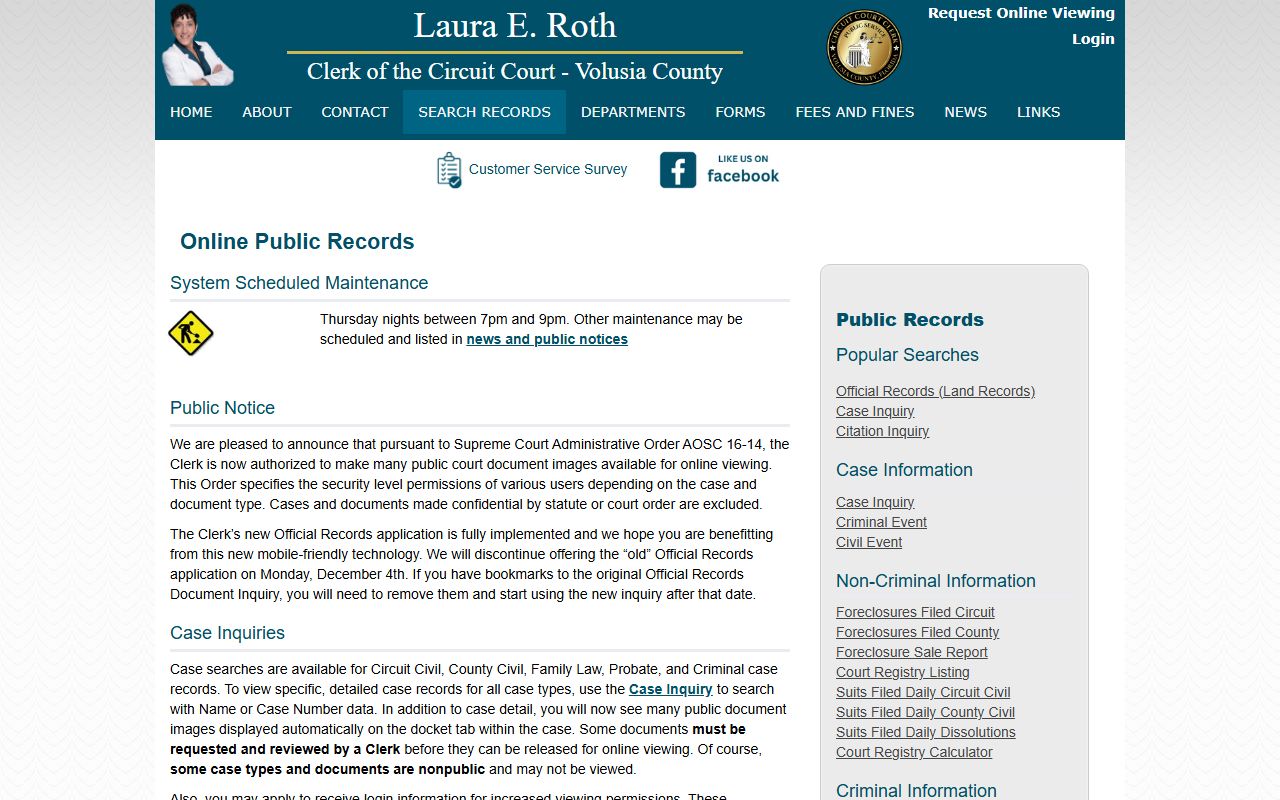
From that page, Case Inquiry is the tool that opens an individual criminal case and shows the filed charges after an arrest.
The Case Management System itself opens with a disclaimer before any search. The image below shows that step.
The Case Management System opens with the notice seen at the Clerk Case Inquiry portal.
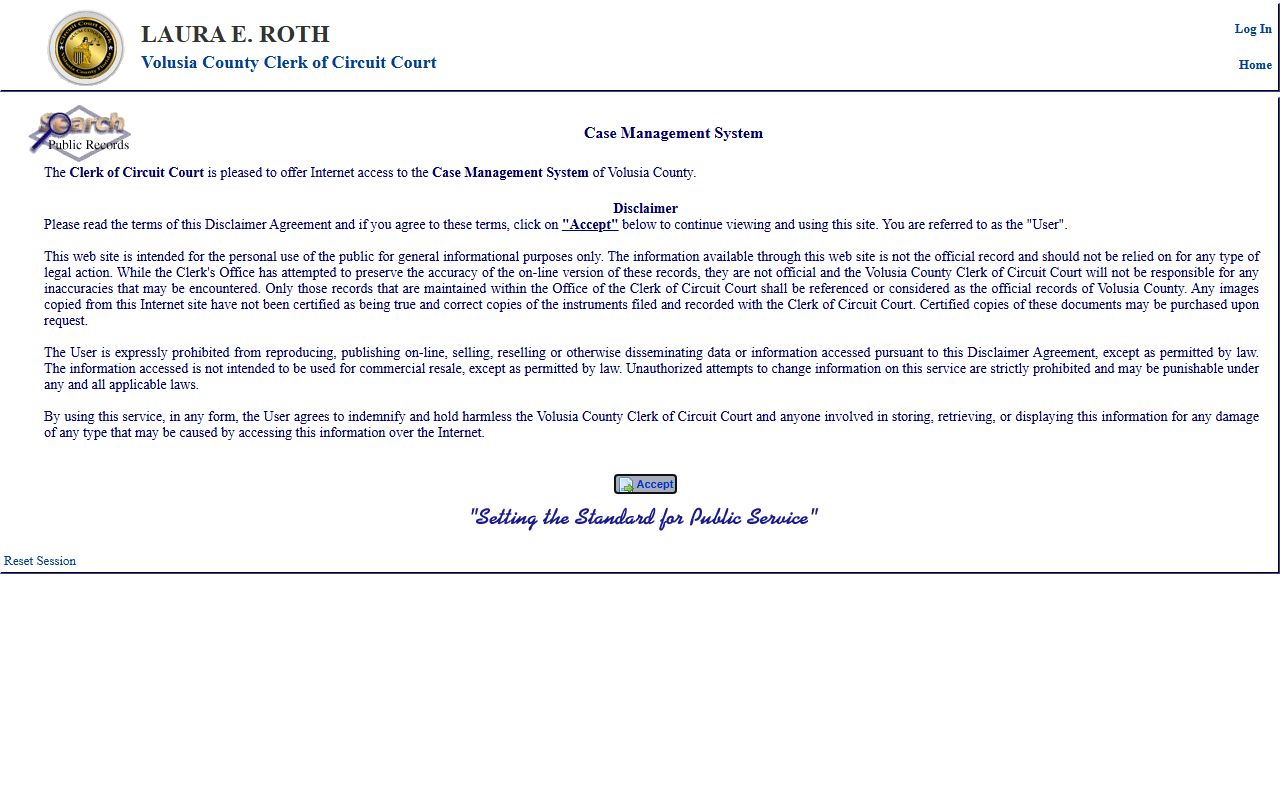
After accepting that notice, the search form opens and lets a user run a name or case-number lookup for the court record.
Volusia County Court Records Search Fields
The Case Inquiry form gives several ways to narrow a search. A case number is the fastest path when you have one. Criminal case numbers in Volusia follow a pattern such as 2023 123456 CFDL, where the suffix marks the case track. CFDL and CFDB are felony tracks, while MMDL and MMDB are misdemeanor tracks. When no case number is known, a person search by name and date of birth works well.
| Search Field | Type | Notes |
|---|---|---|
| Case Number | text | Example 2023 123456 CFDL; CFDB, MMDL, and MMDB suffixes mark felony or misdemeanor tracks. |
| Case Type | dropdown | Options include Felony, Misdemeanor, Felony / Misdemeanor Only, and other case classes. |
| Status | dropdown | Open, Pending, Closed, Closed by Dismissal, In Dismissal, and similar values. |
| Filing Date From / To | date | MM/DD/YYYY range for when the case was filed. |
| Offense Date From / To | date | MM/DD/YYYY range for the date of the offense. |
| Person (Last / First / Middle) | text | Default search mode; a business option is also offered. |
| Date of Birth | date | MM/DD/YYYY; helps separate people with common names. |
A CAPTCHA may appear before the search runs. That step asks the user to prove they are not a bot. The Clerk also notes scheduled maintenance on Thursday nights, so a search may be unavailable for a short window. Note: some document images show on the docket tab right away, while others need a Clerk review or a login approval before they can be viewed online.
How Charges Get Filed After an Arrest: Complaint, Information, and Indictment
The path runs from the arrest forward. Officers book the person at the jail and list arrest charges. The court record truly begins when a charging document is filed. A charging document is the formal paper that states the crime the State will pursue. Florida uses three main types, and which one applies depends on the level of the offense.
| Complaint | Information | Indictment | |
|---|---|---|---|
| Filed By | Officer / Prosecutor | Prosecutor | Grand Jury |
| Common For | Misdemeanors | Many felonies | Serious felonies |
| Starts | The case | The case | The case |
An information is the most common felony charging tool in Florida. The State Attorney drafts and files it. An indictment comes from a grand jury, a panel of citizens, and is used for the most serious felonies. A complaint or citation often starts a misdemeanor. In every form, the filing is what opens the official court record and sets the charges the court will weigh.
Charge Status in Volusia County Court Records
Charges do not stay frozen. As a case moves, the State Attorney can add, amend, reduce, or drop charges. A judge can dismiss them. This is why the booking charges on the jail roster can differ from the charges the State Attorney finally files. The roster shows what the arrest looked like. The court record shows what the prosecutor chose to pursue. The status terms below appear often in case dockets.
| Status | What It Means |
|---|---|
| Pending | The charge is still active and the case is moving through the court. |
| Amended / Reduced | The formal charge has been changed from the arrest charge, often to a lower offense. |
| Dismissed | The court or prosecution is no longer moving forward on that charge. |
| Nolle Prosequi | The prosecutor formally declines to pursue the charge. |
Reading the status across each charge row gives a clearer picture than the arrest alone. A case can have one charge pending and another dropped. Note: a daily snapshot of recent arrests can also be downloaded, but those report files reflect booking data, not the prosecutor's final filing decision.
The Clerk posts daily arrest and booking files that bridge the jail and the court record. The image below shows that download page.
The Clerk Arrest/Booking Download page lists daily PDF and XLSX files of people booked in the prior 24 hours.
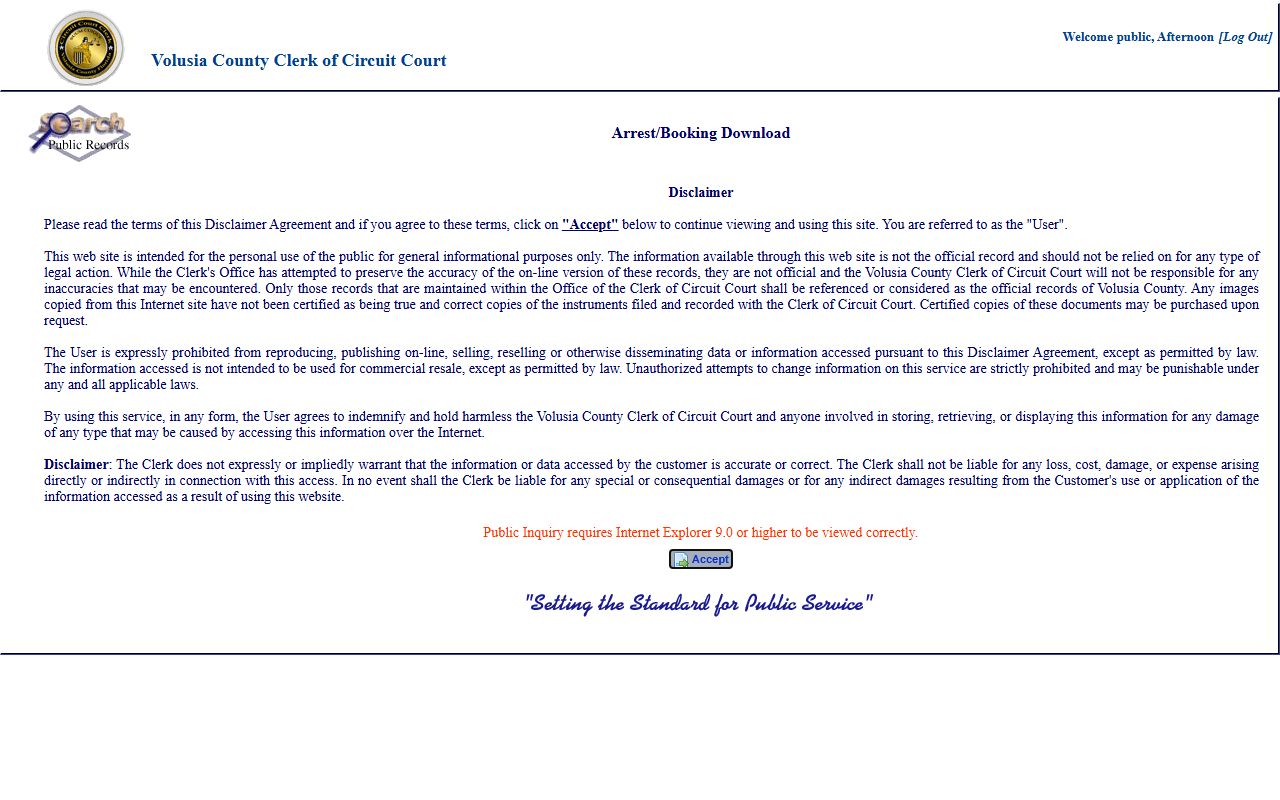
Those daily files come from the county jail management system and stay online about fourteen days, so they help confirm a recent booking before the case shows in Case Inquiry.
Bond and Release After an Arrest
Bond is usually set at First Appearance. A bond is the money or set of conditions that allows release while the case goes on. An administrative court order sets a starting bond schedule based on the crime charged. If a warrant exists, the judge who issued the warrant sets the amount. At First Appearance, the judge can raise or lower the bond or release the person on their own recognizance. Bond is posted at the Volusia County Branch Jail, where the Booking Office runs 24/7 and bond information is available at 386-254-1555.
| Bond Type | How It Works |
|---|---|
| Cash Bond | Money posted directly to secure release, handled through the Branch Jail bond process. |
| Surety Bond | A licensed bondsman posts the bond; the county says anyone may post bond through a bondsman. |
| PR / Own Recognizance | The judge releases the person without money bond, subject to set conditions. |
| No-Bond Hold | The profile can show NO BOND; no money release is offered for that charge until the court changes it. |
A warrant bond is a special case. The issuing judge sets the amount on the warrant, and that figure may change at a later hearing. Paying a bond does not always free a person. Hold situations can block release even after a bond is paid. A detainer from another agency, a hold for a different jurisdiction, a no-bond charge, or a pending state-prison transfer can all keep someone in custody. Note: the county warns that no jail employee will ever demand bond money by Zelle, Cash App, or similar apps, and such calls are likely scams.
Warrants That Lead to a Volusia County Arrest
A warrant is often what brings a person into the jail in the first place. When a defendant misses a scheduled court date, the judge may issue a capias or bench warrant. A capias is a court order or warrant that directs an arrest, often after a failure to appear. A bench warrant is a judge-issued warrant for the same kind of reason. Once the warrant leads to an arrest, the person can show on the Volusia Inmate Inquiry after booking.
The Clerk routes capias and bench-warrant questions to the Volusia County Sheriff's Office, because the Clerk cannot give out that information. So warrant status checks go to the Sheriff or the issuing court, not the Clerk. For a broader look, the Florida Department of Law Enforcement runs a statewide Wanted Persons Search. It pulls from records entered by Florida agencies and updates from state files every 24 hours. A CAPTCHA is required, and at least the last two letters of the last name must be entered. The FDLE warns that a result is not confirmation of an active warrant and is not grounds for an arrest by a member of the public.
Charges vs. Convictions in the Court Record
An arrest and a charge are not the same as a conviction. A charge is an accusation. A conviction is a final result, reached by a verdict or a plea. A person can be arrested, charged, and later cleared. Court records can show every stage, so it matters to read past the arrest to the outcome.
| Charge | Conviction | |
|---|---|---|
| Stage | Accusation | Verdict or plea |
| Burden of Proof | Probable cause | Beyond reasonable doubt |
| Public Record | Yes | Yes |
The legal weight differs at each step. A charge rests on probable cause. A conviction must be proven beyond a reasonable doubt. Both can appear in public court records, but treating a charge as a conviction is a common and serious mistake.
Sealed vs. Expunged Arrest Records
Some criminal records can be hidden or removed after an eligible disposition. A sealed record is hidden from ordinary public access by a court order. An expunged record is ordered destroyed or restricted and is treated as though it never existed, subject to narrow legal exceptions. In Florida, both routes start with a certificate of eligibility from the Florida Department of Law Enforcement.
| Sealed | Expunged | |
|---|---|---|
| Visibility | Hidden from public | Destroyed / treated as never existed |
| Law Enforcement | Limited access | Very limited |
| Eligibility | Court-ordered under Fla. Stat. 943.059 | Court-ordered under Fla. Stat. 943.0585 |
The process runs through the FDLE seal and expunge program before a court can order relief. Sealing is set out in Fla. Stat. 943.059, and expunction in Fla. Stat. 943.0585. A sealed court file needs a court order before its contents can be viewed. Note: a sealed or expunged court record does not force a private commercial site to comply, so that is a separate matter from the official court and state files.
Requesting Volusia County Court and Arrest Records
Some records are not online or need to be certified. The Clerk handles copies and searches through a Criminal/Traffic Copy/Record Search Request. Copies cost $1 per page, plus $2 per document to certify. A staff record search costs $2 per name per year searched. The completed request can be emailed to dispositionrequests@clerk.org, faxed to 386-740-5175, or delivered in person or by mail. The Clerk then contacts the requester to arrange payment.
| Request Item | Cost |
|---|---|
| Copy of a court record | $1.00 per page |
| Certification of a document | $2.00 per document |
| Staff record search | $2.00 per name, per year searched |
Other offices hold other pieces of the record. The State Attorney accepts public records requests for prosecution files and decisions. The Volusia Sheriff's Office Records Section handles incident reports and charging affidavits generated by VSO. For the most recent bookings, the Clerk also posts a daily Arrest/Booking Download covering the prior 24 hours, with files kept online about fourteen days.
The Clerk criminal department page lays out file access, fees, and request methods in one place. The image below shows that page.
The Clerk criminal records page explains public file access, copy fees, and sealing or expunging guidance.
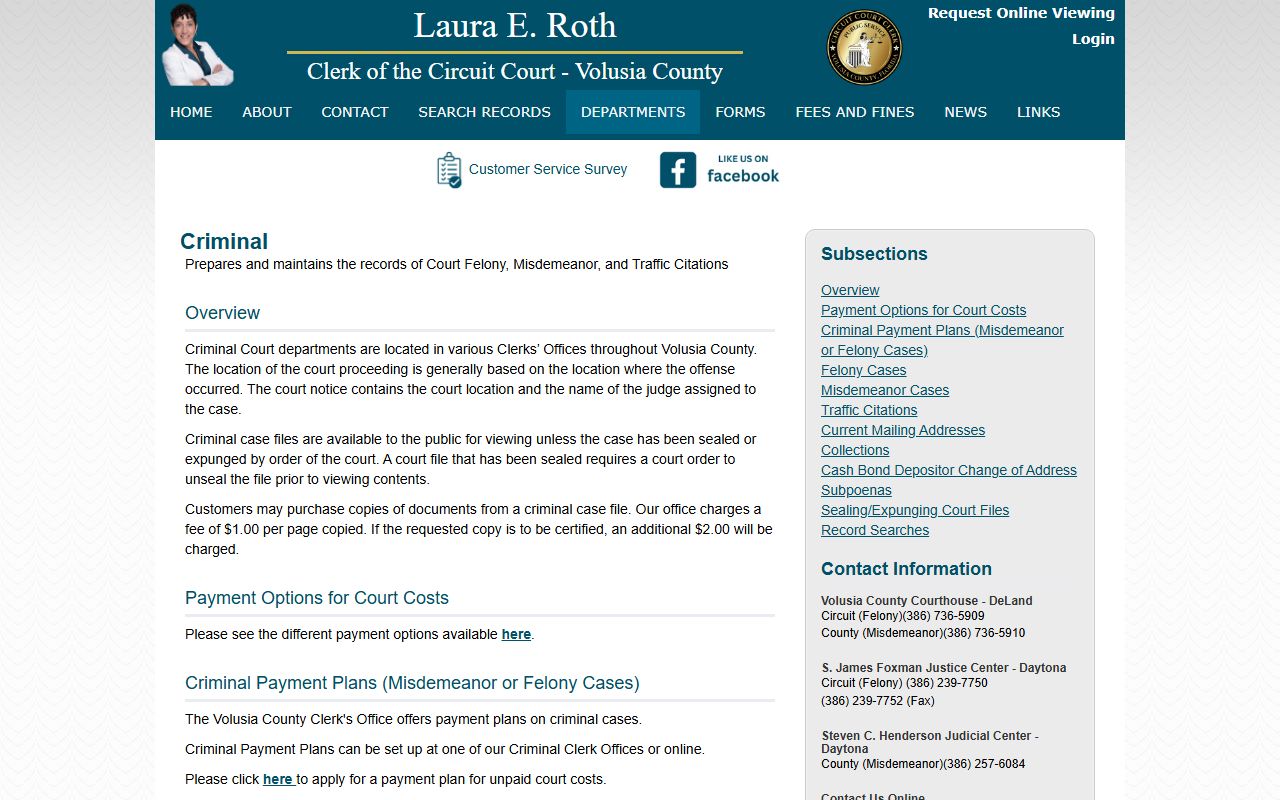
That page is the best single starting point when a court record needs a certified copy or a formal search rather than a quick online lookup.
Background Check Considerations
Casual court-record lookups are not the same as a regulated background check. The Fair Credit Reporting Act, or FCRA, governs reports used for credit, employment, housing, and insurance decisions. Those reports must come from a licensed consumer reporting agency that follows strict accuracy and dispute rules. A quick search of a county case index does not meet that standard.
Important: Volusia County Inmate Population is not an FCRA-regulated consumer reporting agency, and its information may not be used for credit, employment, tenant, or insurance screening.
Restricted Court Records After an Arrest in Volusia County
Not every record tied to an arrest is open to the public. Florida law favors access, but it carves out clear limits. Juvenile cases are largely shielded. Sealed and expunged records are removed from ordinary public view by court order. A charge that was dismissed may still be withheld in some forms, and a sealed court file cannot be read without a court order. Active investigations stay closed while they are open.
The Sheriff's Records Section warns that an open report, or one tied to a pending capias, may be unavailable to the public until the case closes, except to a victim or a victim's representative. Some serious open cases may be limited even then. Florida's public-record exemptions in Fla. Stat. 119.071 protect active investigative material and certain victim information. So an arrest can produce a quick jail booking, while the deeper charging affidavit or court file stays restricted for a time. When a record is blocked, the path forward is the issuing court, the proper agency, or legal counsel.